
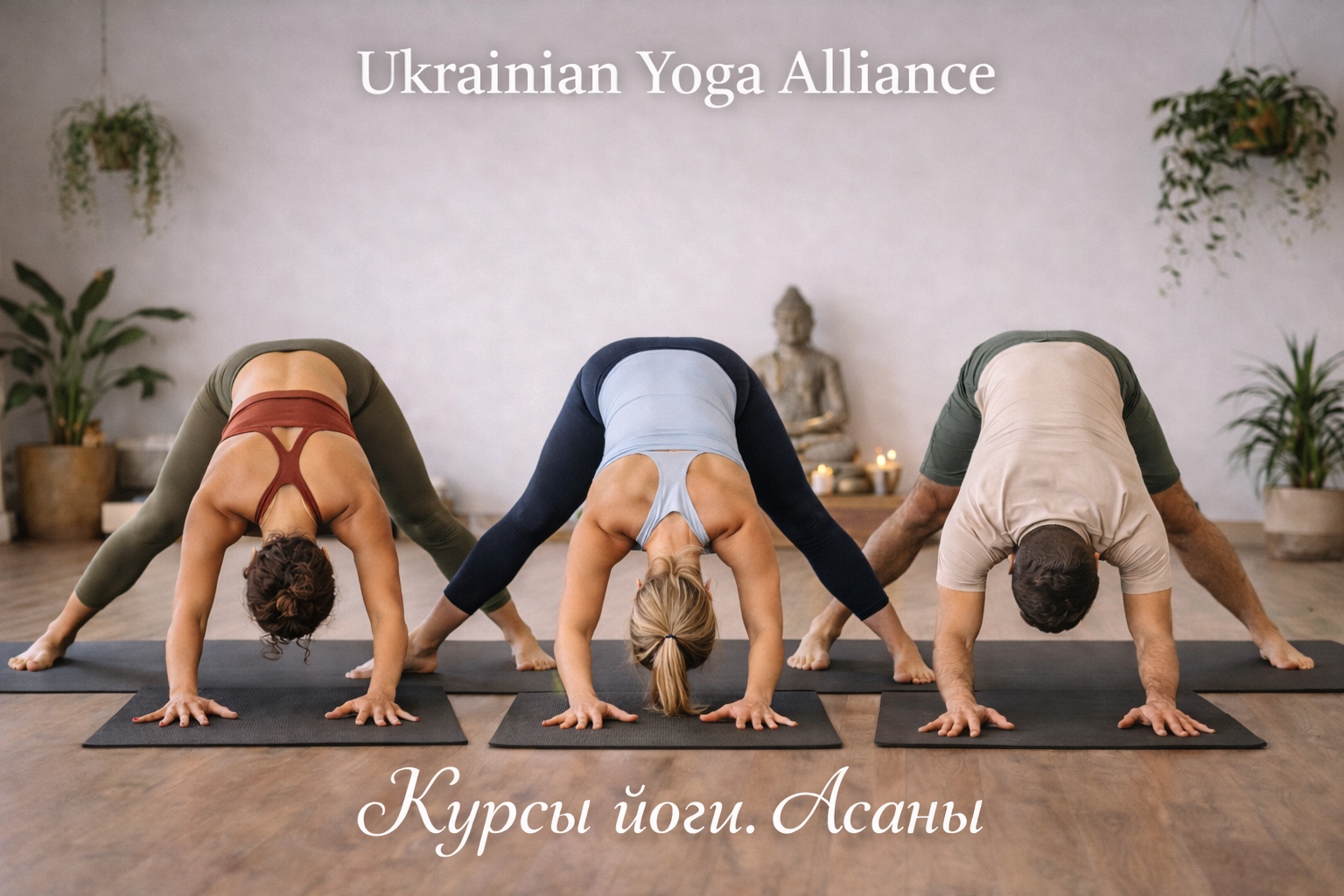
Prasarita Padottanasana, Utthita Trikonasana and Parivrtta Trikonasana
You can read more about the Yoga Instructor Course on the course website:
kurspoyoge.com
Course registration:
📞 Phone: +380984777777
(Viber / Telegram / WhatsApp)
Yoga Alliance website:
yogaalliance.com.ua
Teaching Methodology of Standing Asanas in Professional Yoga Instructor Training
In the system of classical Hatha Yoga, standing asanas occupy a fundamental place in the education of future yoga teachers. This section of practice develops essential movement patterns required for the safe performance of more advanced postures, including forward bends, backbends, balances, and inversions.
Standing postures cultivate stability, establish proper axial alignment of the spine, improve coordination, and develop an understanding of weight distribution throughout the body. Through these positions, the connection between breath, movement, and concentration is established.
Prasarita Padottanasana, Utthita Trikonasana, and Parivrtta Trikonasana are considered core methodological postures within professional yoga teacher training programs, as they simultaneously develop stabilization, extension, joint opening, and spatial body awareness.
Systematic mastery of these asanas forms understanding of three essential principles of Hatha Yoga practice:
•extension,
•stability,
•spinal rotation.
Prasarita Padottanasana
(Wide-Legged Intense Forward Fold)
Meaning
Sanskrit terminology:
•Prasarita — expanded, spread wide
•Pada — foot
•Uttana — intense extension
This asana represents a symmetrical forward fold with deep stretching of the posterior chain of the body.
Focus of Attention
Muladhara Chakra
Svadhisthana Chakra
The posture develops grounding, stability, and internal balance.
Biomechanical Significance
The primary movement occurs in the hip joints while maintaining spinal length.
Active muscular engagement includes:
•hamstrings,
•adductor muscles,
•spinal extensors,
•deep core stabilizers.
The key principle of execution is that the forward fold originates from the pelvis rather than spinal rounding.
Technique
1.Begin in Tadasana.
2.Step the feet wide apart.
3.Keep the feet parallel.
4.Activate the leg muscles.
5.Extend the arms sideways at shoulder level.
6.Lengthen the spine upward.
7.Fold forward maintaining spinal extension until the torso is parallel to the floor.
8.Place the palms beneath the shoulders.
9.Extend the spine forward.
10.Direct the crown of the head toward the floor.
11.Body weight remains primarily in the legs.
12.Knees stay active and extended.
13.Exit by lengthening the torso and returning to standing.
Teaching Methodology
The instructor supervises:
•even weight distribution through the feet;
•avoidance of knee hyperextension;
•pelvic neutrality;
•spinal elongation;
•prevention of excessive weight transfer into the head and arms.
Counterpose
Gentle back extension or neutral spine position.
Benefits
The posture:
•deeply stretches the posterior body line;
•improves venous circulation;
•increases blood flow to the brain;
•stimulates abdominal organs;
•supports metabolic balance;
•reduces lumbar tension;
•improves posture.
Contraindications
•severe varicose veins;
•sciatic nerve inflammation;
•acute lower back pain;
•hypertension.
Utthita Trikonasana
(Extended Triangle Pose)
Meaning
•Utthita — extended
•Trikona — triangle
This asana develops lateral extension and spatial awareness of pelvic and thoracic alignment.
Focus of Attention
Muladhara Chakra
Svadhisthana Chakra
Promotes stability and body symmetry.
Category
Standing lateral extension posture.
Technique
1.From Tadasana, step the feet wide apart.
2.Extend the arms sideways.
3.Turn the front foot outward and the back foot slightly inward.
4.Extend the torso forward.
5.Place the lower hand on the shin, floor, or support block.
6.Extend the upper arm vertically upward.
7.Stack the shoulders in one plane.
8.Open the chest.
9.Direct the gaze upward.
10.Repeat on the opposite side.
Teaching Considerations
•pelvis remains stable;
•torso stays in one plane;
•lower side body lengthens;
•avoid pressure on the knee joint;
•maintain activity in both legs.
Benefits
The posture:
•increases hip mobility;
•strengthens the spine;
•improves digestion;
•releases muscular tension;
•expands the chest;
•enhances respiratory capacity;
•stabilizes the nervous system.
Contraindications
•cervical spine disorders;
•cardiovascular conditions;
•severe varicose veins.
Parivrtta Trikonasana
(Revolved Triangle Pose)
Meaning
•Parivrtta — revolved, rotated
•Trikona — triangle
This posture combines forward folding, axial extension, and spinal rotation.
Focus of Attention
Muladhara Chakra
Manipura Chakra
Activates the center of internal strength and control.
Category
Standing twisting posture.
Technique
1.Take a wide stance from Tadasana.
2.Turn the front foot outward.
3.Turn the back foot inward.
4.Lengthen the spine.
5.Rotate the torso toward the front leg.
6.Place the opposite hand outside the front foot.
7.Extend the upper arm upward.
8.Arms form a vertical line.
9.Gaze toward the upper hand.
10.Perform on both sides.
Methodological Principles
•rotation originates primarily from the thoracic spine;
•pelvis remains stable;
•both feet are firmly grounded;
•spinal elongation precedes rotation.
Benefits
The posture:
•improves spinal circulation;
•strengthens back muscles;
•enhances posture;
•stimulates abdominal organs;
•reduces nervous tension;
•tones leg muscles.
Contraindications
•pregnancy;
•spinal hernia;
•disc protrusions;
•acute spinal pain;
•severe varicose veins.
Methodological Importance in Yoga Teacher Training
Mastery of these postures develops essential professional competencies:
•understanding biomechanics;
•center of gravity control;
•safe execution of forward bends and twists;
•proper pelvic and spinal alignment;
•verbal instruction skills;
•ability to adapt practice for different student levels.
A professional yoga instructor must understand not only the external form of an asana but also its functional, therapeutic, and pedagogical significance.
Conclusion
Classical yoga considers asana not merely as physical exercise but as a tool for harmonizing body, breath, and consciousness.
Systematic practice of Prasarita Padottanasana, Utthita Trikonasana, and Parivrtta Trikonasana establishes the foundation for safe teaching and represents an essential component of professional yoga instructor training.
Yoga may replace many medicines; however, no medicine can replace yoga.
Teacher Training and Certification
The Ukrainian Yoga Alliance is the largest non-profit organization responsible for establishing and maintaining yoga teaching standards in Ukraine.
The main areas of activity of the Alliance include:
•uniting the professional yoga community;
•developing and approving qualification requirements;
•official certification of yoga instructors;
•maintaining the Unified Register of Certified Teachers.
The Ukrainian Yoga Alliance is the largest non-profit organization that establishes and maintains yoga teaching standards in Ukraine.
The main areas of activity of the Alliance include:
•uniting the professional yoga community,
•developing and approving qualification requirements,
•official certification of yoga instructors,
•maintaining the Unified Register of Certified Yoga Teachers.
Training Format and Examination
Within online yoga instructor training courses, students of the Yoga Alliance School undergo mandatory practical and theoretical assessment.
Passing Surya Namaskar is part of the examination process.
A video of the exam, conducted within online courses, is available via the link — click to watch.
You can watch a full video overview of the online course by the Head of the Yoga Alliance, Vladimir Bondarenko, on our YouTube channel by following the link.
Training Locations and Tuition Fees
Branches of the Yoga Alliance School have resumed operations in the following cities:
• Kyiv
• Kharkiv
• Dnipro
• Odesa
• Lviv
• Klaipėda (Lithuania)
• Bansko (Bulgaria)
• Athens (Greece)
• Prague (Czech Republic)
• Torrevieja (Spain)
• Vienna (Austria)
• Cascais (Portugal)
These branches offer continuously running offline yoga instructor training courses led by senior instructors of the Alliance.
Tuition fees:
•online course — 15,500 UAH
•offline course — 17,500 UAH
Since August 2022, instructors who successfully pass examinations with distinction receive the right to train future yoga instructors on behalf of the Yoga Alliance and conduct teacher training courses jointly with the Organization.
Such instructors receive the status of Senior Instructor of the Yoga Alliance and earn 50% of the course fee for each student.
For full details, contact us via Viber / Telegram / WhatsApp:
+380984777777
Training Results
After completing the one-month course and successfully passing the exams, you will:
•receive two international Yoga Alliance certificates registered with the Ministry of Justice of Ukraine;
•obtain the right to teach yoga in more than 100 countries worldwide;
•master a well-structured class format including kriyas, pranayama, and meditation;
•receive lifetime access to video lessons, an application for learning posture names, and 12 balanced printed lesson plans for the first year of teaching;
•receive the “Gold Standard” methodological guide — a detailed manual on asanas, chakras, mudras, bandhas, and key techniques of classical yoga.
Additional Materials
Contacts and Registration
You can read more about the Yoga Instructor Course on the course website:
Course registration:
📞 Phone: +380984777777
(Viber / Telegram / WhatsApp)
Yoga Alliance website:
Оставить комментарий